
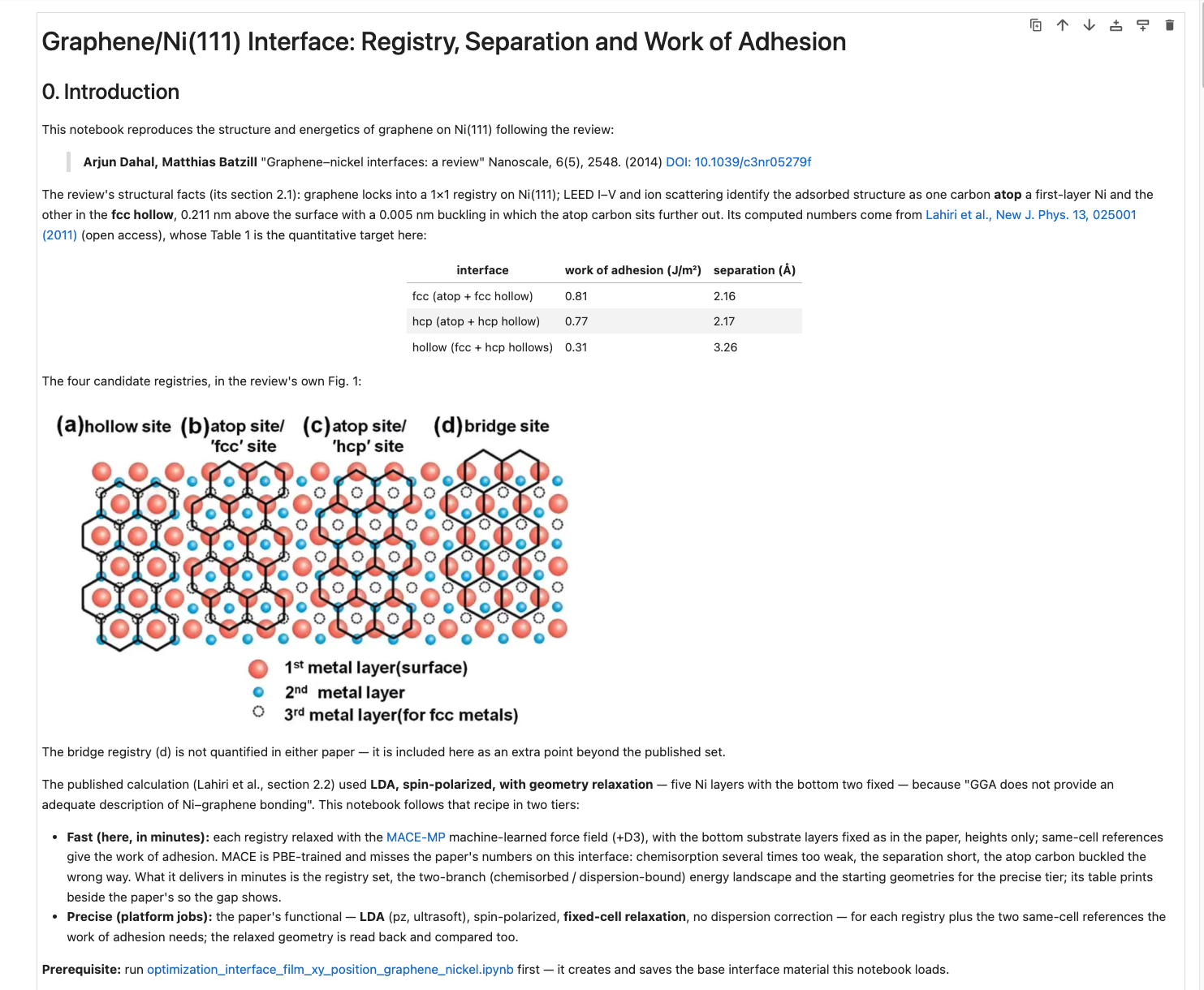
Release 2026.9.24 introduces multiple fixes and new capabilities. We highlight (1) a new example reproducing the registry, separation and work of adhesion of graphene on Ni(111); (2) a new tutorial calculating the formation energy of a boron vacancy in hexagonal boron nitride; and (3) new REST API endpoints for uploading files and changing the type of an entity set.

Release 2026.9.24 introduces multiple fixes and new capabilities. We highlight (1) a new example reproducing the registry, separation and work of adhesion of graphene on Ni(111); (2) a new tutorial calculating the formation energy of a boron vacancy in hexagonal boron nitride; and (3) new REST API endpoints for uploading files and changing the type of an entity set.
A new notebook reproduces the structure and energetics of graphene on Ni(111) following the review by Dahal and Batzill (Nanoscale, 2014) and the calculations of Lahiri et al. (New J. Phys., 2011). It relaxes each candidate registry - fcc, hcp, hollow and bridge - to obtain the graphene-metal separation and the work of adhesion. A fast tier uses the MACE-MP machine-learned force field and runs in minutes; a precise tier submits platform jobs with the LDA functional used in the publication:
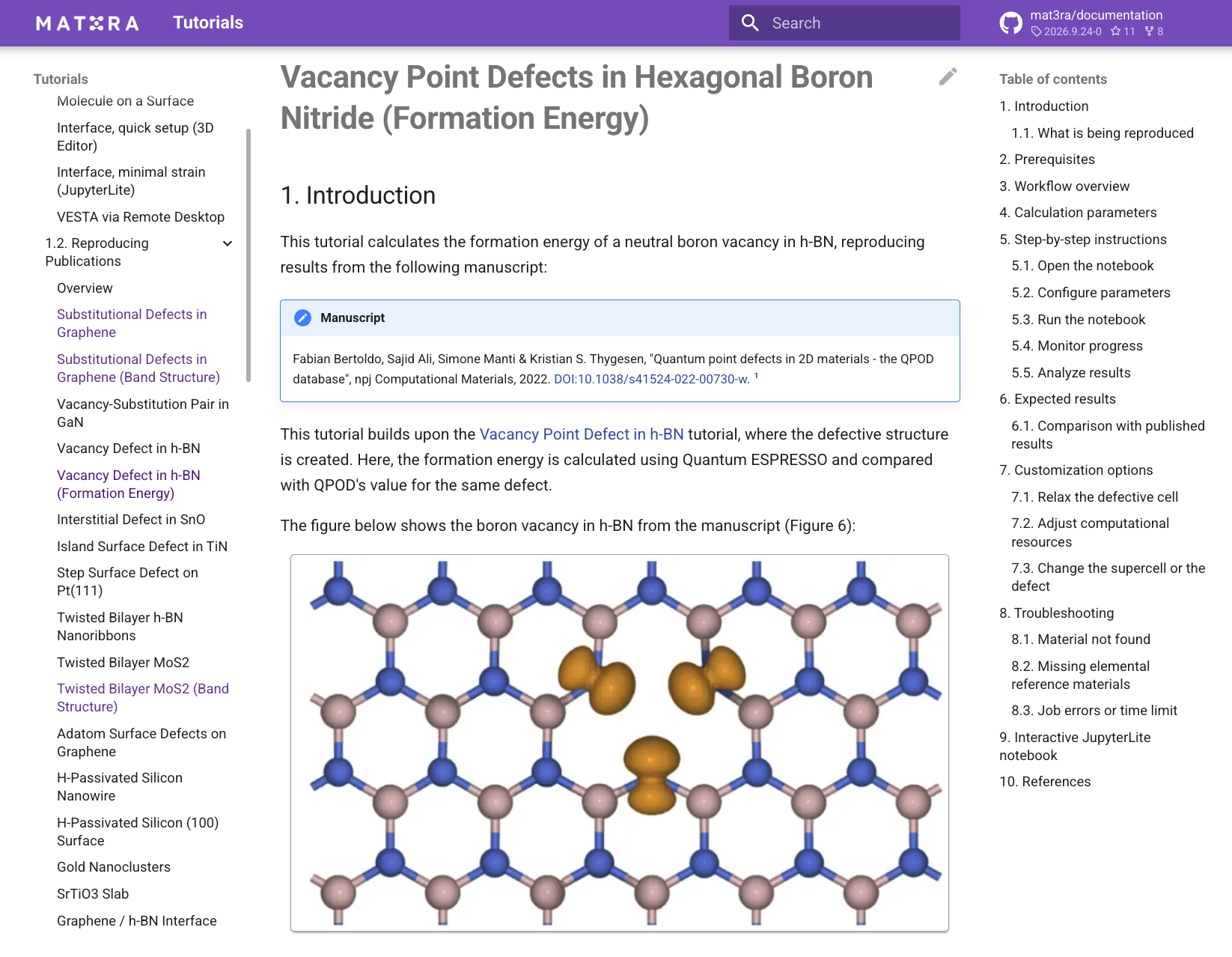
A new tutorial calculates the formation energy of a neutral boron vacancy in h-BN with Quantum ESPRESSO and compares the result against the QPOD database of quantum point defects in 2D materials (Bertoldo et al., npj Computational Materials, 2022). It builds on the existing tutorial that creates the defective structure:
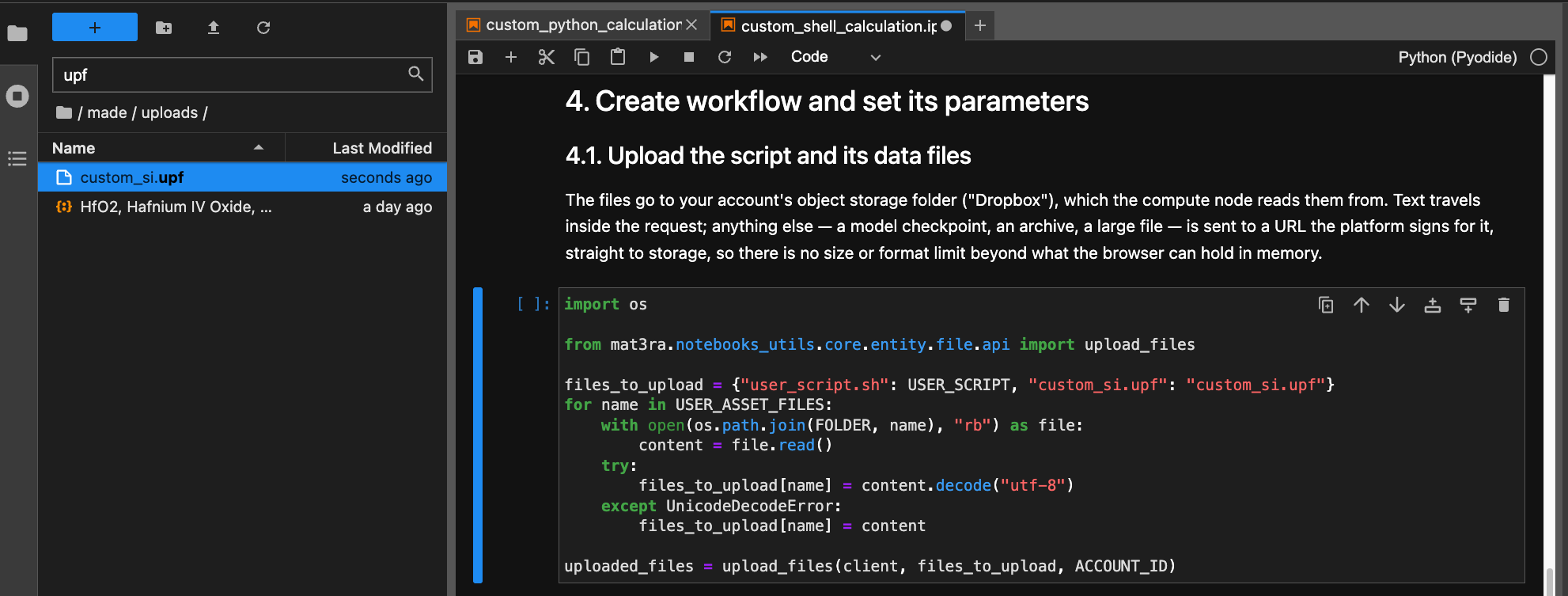
The external REST API now supports uploading files to the account's object storage ("Dropbox"), which compute nodes read from. Text files travel inside the request, while larger or binary files - model checkpoints, archives, pseudopotentials - go to a signed URL straight to storage. The example notebooks use this to ship custom scripts and data files with a workflow. A second new endpoint changes the type of an entity set, for example to an ordered material set:
Try the new functionality online at https://platform.mat3ra.com/

Exabyte Inc.
1212 Broadway Plaza, Ste #2100 Walnut Creek, CA 94596
+1 (510) 473 7770
info@mat3ra.com
Mat3ra Japan K.K.
Otemachi Building 6F Inspired Lab,
1-6-1, Otemachi, Chiyoda-ku, Tokyo 100-0004 Japan


