
Mat3ra has announced a new paper, AI-ready design of realistic 2D materials and interfaces with Mat3ra-2D, introducing an open-source framework for the rapid and reproducible design of realistic 2D materials, surfaces, and interfaces. The work addresses a key limitation in current AI/ML materials datasets, which are often based on ideal bulk crystals rather than real-world structures shaped by surfaces, interfaces, and defects.

Mat3ra has introduced a new paper, AI-ready design of realistic 2D materials and interfaces with Mat3ra-2D, authored by Vsevolod Biryukov, Kamal Choudhary, and Timur Bazhirov. The paper presents Mat3ra-2D as an open-source framework for the rapid design of realistic two-dimensional materials and related structures, including slabs and heterogeneous interfaces.
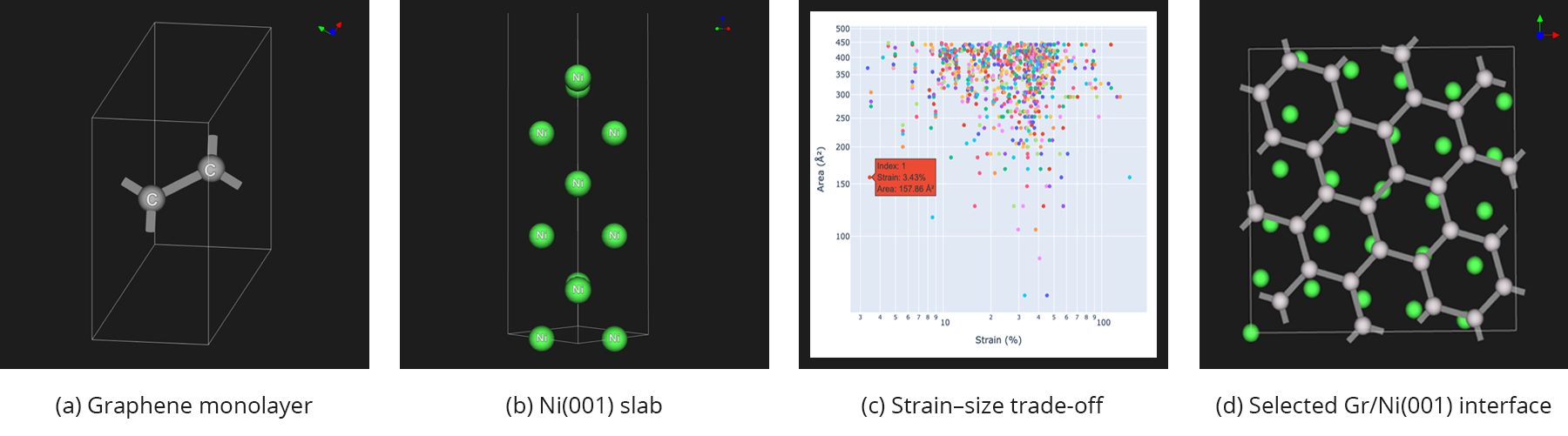
The work addresses a central challenge in AI and machine learning for materials science: many existing models are trained on ideal bulk crystals, while real-world applications are often governed by surfaces, interfaces, and defect-driven complexity. To bridge that gap, Mat3ra-2D is designed to support realistic structure generation with disorder- and defect-aware workflows that are better aligned with experimental and applied research settings.
The framework combines well-defined standards for storing and exchanging materials data with modular transformation workflows expressed as configuration-builder pipelines that preserve provenance and metadata. The authors also describe reusable Jupyter Notebook implementations for common structure-generation tasks such as orientation-specific slab construction and strain-matching interface design, allowing these workflows to serve both as interactive documentation and as templates for reproducible runs.
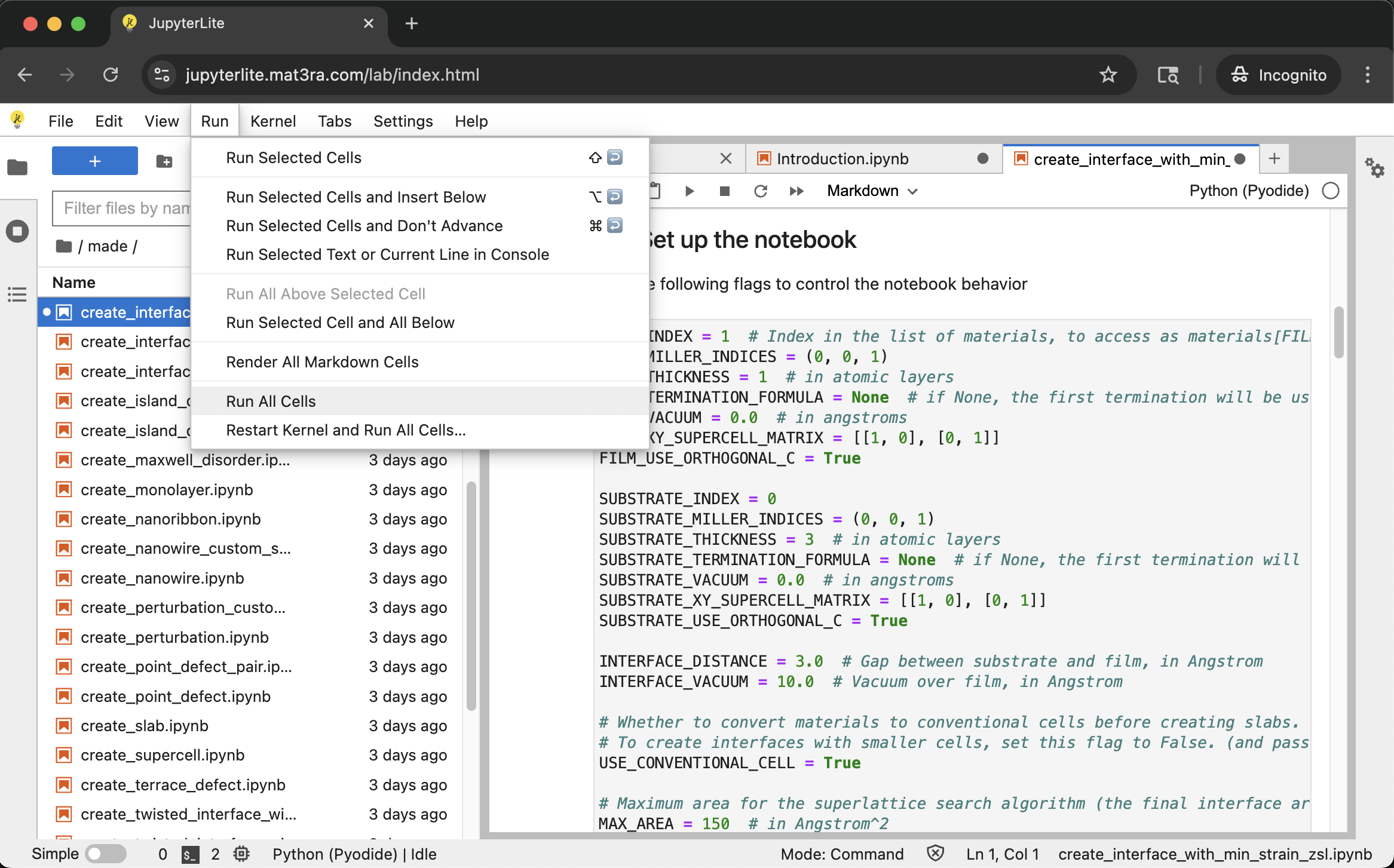
A key emphasis of the work is accessibility and practical adoption. The examples are designed to run in a web browser, and the authors show how these capabilities can be incorporated into a web application. In this way, Mat3ra-2D supports the systematic creation and organization of realistic, 2D- and interface-aware datasets for AI/ML-ready applications.
The publication builds on Mat3ra’s broader work around surfaces, interfaces, and heterostructures, reinforcing the company’s focus on reproducible, simulation-driven, and AI-enabled infrastructure for next-generation materials R&D.
Vsevolod Biryukov, Kamal Choudhary, Timur Bazhirov
Read the paper:
AI-ready design of realistic 2D materials and interfaces with Mat3ra-2D
https://arxiv.org/abs/2603.27886
#Mat3ra #Mat3ra2D #2DMaterials #MaterialsInterfaces #Heterostructures #MaterialsScience #ComputationalMaterialsScience #AIMaterials #AIReadyData #OpenSourceScience #SimulationDrivenRandD #MaterialsModeling #arXiv

Exabyte Inc.
1212 Broadway Plaza, Ste #2100 Walnut Creek, CA 94596
+1 (510) 473 7770
info@mat3ra.com
Mat3ra Japan K.K.
Otemachi Building 6F Inspired Lab,
1-6-1, Otemachi, Chiyoda-ku, Tokyo 100-0004 Japan


