
Mat3ra has added support for the NVIDIA ALCHEMI Toolkit 0.3.0. In its first benchmark on the Mat3ra platform, one NVIDIA H100 NVL GPU relaxed crystal structures 40-60x faster than the conventional one-at-a-time approach. Platform users can run the same workflow from a notebook, with no software to install and no GPU to buy.

AI can now propose new materials faster than anyone can test them. Every model-proposed candidate must be relaxed into a stable structure, heated, strained and checked for defects before anyone knows whether it is worth making. That testing is the bottleneck of AI-driven materials discovery. Mat3ra aims to clear it from both ends: the Mat3ra platform simplifies the process of running simulations, leveraging NVIDIA ALCHEMI for acceleration of the simulations themselves.
At the core of the work is NVIDIA ALCHEMI Toolkit 0.3.0, which makes it possible to simulate hundreds of structures at once on a single GPU instead of one at a time. In its first benchmark on the Mat3ra platform, one NVIDIA H100 NVL GPU relaxed crystal structures 40-60x faster than the conventional one-at-a-time approach: 4,000 structures in about three minutes, where the conventional route needs close to 3 hours. The Mat3ra platform then improves the user experience and accessibility. Mat3ra platform users can run the same workflow from a notebook, with no software to install and no GPU to buy, and plug in their own structures, compositions and use cases on top of the setup tuned by the NVIDIA ALCHEMI team.
A data-center GPU is built for massive parallel work. A single small crystal is not enough to saturate capacity, so conventional tools that handle one structure at a time such as the widely used Atomic Simulation Environment (ASE) [4] leave most of the GPU idle.
With the ALCHEMI Toolkit [1], NVIDIA’s open-source framework for AI-powered atomic simulation, hundreds of structures can be evaluated in one pass and advanced together, keeping the GPU fully utilized. NVIDIA cuEquivariance [2] accelerates the MACE machine-learned interatomic potential [3] underneath. The result is substantially higher throughput from one GPU.
Relaxation is only the start. Molecular dynamics at set temperature and pressure can also be run with the same batched engine. Version 0.3.0 adds faster optimizers, reaction- and diffusion-path searches, enhanced sampling, and a direct pipeline from generative AI models into simulation. Whatever an AI model proposes, ALCHEMI can now test in bulk.
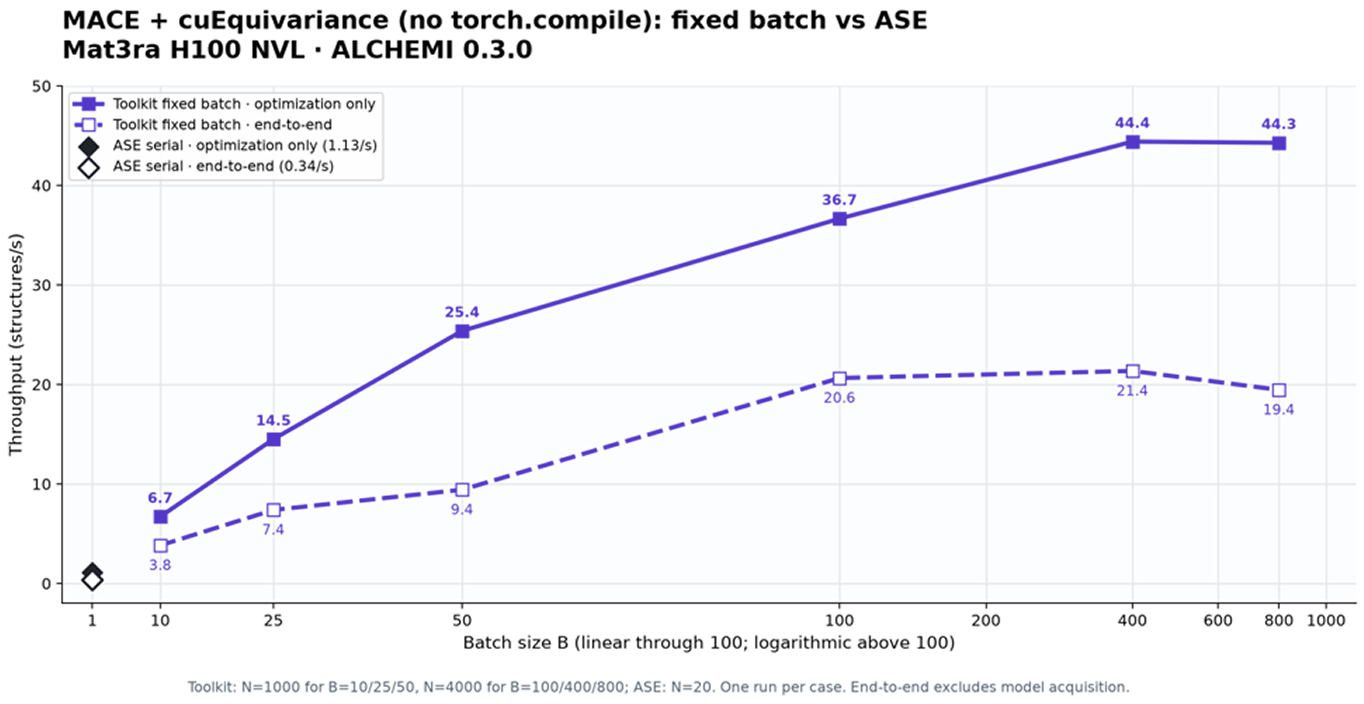
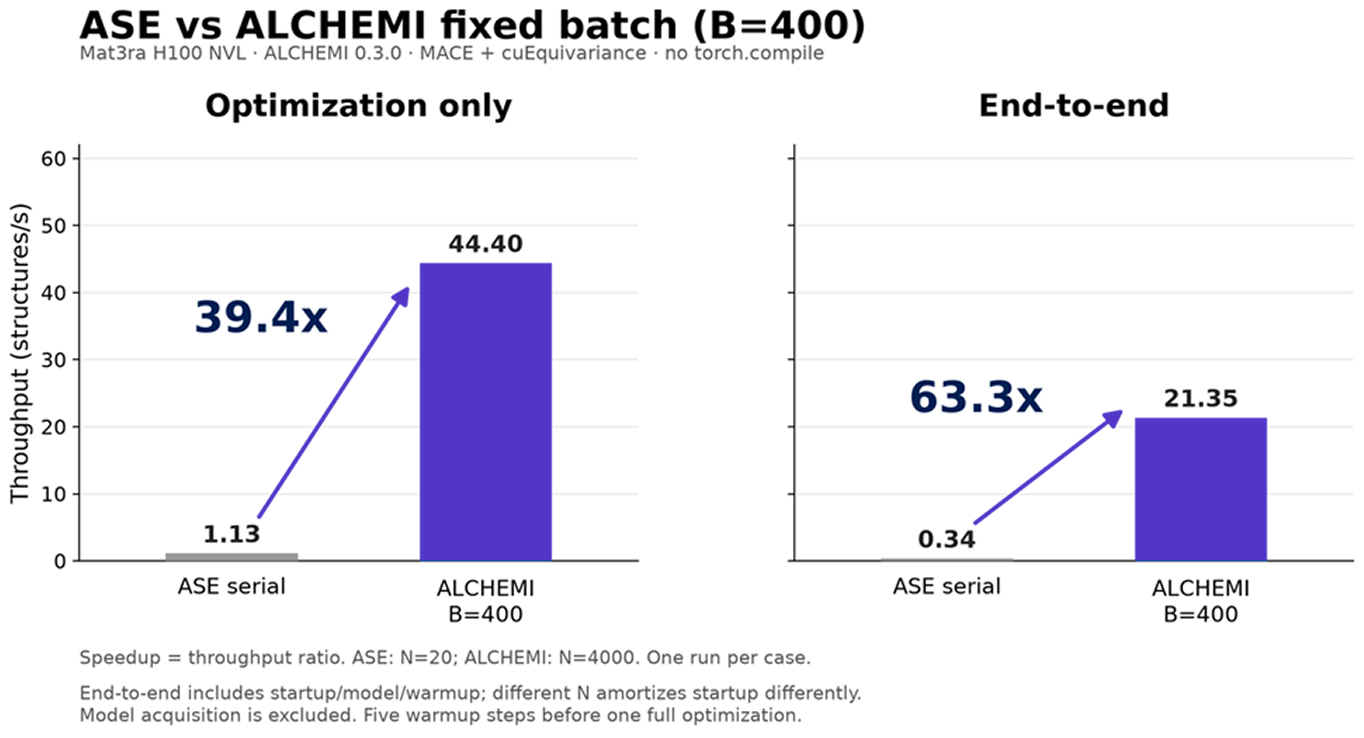
Throughput climbs with batch size until a few hundred structures fill the GPU. At a batch of 400, the throughput with ALCHEMI was 44 structures per second in the optimization phase and 21 per second end to end, against 1.1 and 0.34 per second one at a time. This is roughly 40 and 60 times end-to-end acceleration. The batched and one-at-a-time results are consistent, so the speed costs nothing in accuracy.
On the Mat3ra platform, the whole benchmark is one Jupyter notebook. It builds the structures from the platform’s materials library, saves them as a set, and submits one job per method to a GPU queue. The platform hands the structures to the workflow, installs the toolkit and its GPU dependencies on the node, and returns the results as a table, all without a terminal. The notebook runs in the browser through the platform’s built-in JupyterLite, or locally through the Mat3ra API.
A research campaign works the same way. Swap in your own structures, or a dynamics or reaction-path script, and the rest of the workflow stays put. Fifty structures or fifty thousand, the notebook does not change; only the set does.
Neither half works without the other. A 40x speed-up helps only the labs that can set it up, and an easy platform helps only if what it runs is fast. This work combined NVIDIA’s engineering on the toolkit and the benchmark with Mat3ra’s platform and workflow engineering, running on Mat3ra’s own H100 NVL nodes, so that users get both at once. The Mat3ra platform, which provides physics-grounded infrastructure for AI-driven materials R&D to more than 40,000 registered users, keeps that kind of collaboration in one place: structures, workflows, jobs and results belong to the team’s organization account, so everyone works from the same data and sees the same results. The notebook will be public in Mat3ra’s API examples repository [5], ready to rerun or adapt.
“Exploring different atomic pathways, including structural relaxation, temperature dependence, the behavior of defects and impurities, and other effects arising in real-world materials and manufacturing, requires searching enormous phase spaces. With ALCHEMI on the Mat3ra platform, we can perform thousands of explorations in batched mode in minutes. The workflow is modular: our users plug in their own structures, compositions and use cases while building on the optimal setup from the NVIDIA ALCHEMI team.”
Timur Bazhirov, CEO of Mat3ra
“The Mat3ra platform is intuitive to use, and flexible to bring ALCHEMI quickly. It puts the full performance of the GPU within easy reach of end users, with no environment to set up. ALCHEMI is under very active development, and on Mat3ra users can try its latest features right after each release. As AI models propose more candidates than ever, this lets researchers test them in bulk and reach validated materials faster.”
Geetika Gupta, Senior Director Product Management at NVIDIA
The ALCHEMI Toolkit is on GitHub [1], with documentation at https://nvidia.github.io/nvalchemi-toolkit/. Sign in or create a free account at https://platform.mat3ra.com, and find the notebook in Mat3ra’s API examples repository [5].
Geometry-relaxation measurements on one configuration, one run per case; throughput varies with operation, structures, model, settings and hardware. Trademarks belong to their respective owners.
NVIDIA ALCHEMI cuEquivariance MACE MLIP BatchedSimulation GPU MaterialsInformatics Mat3ra

Exabyte Inc.
1212 Broadway Plaza, Ste #2100 Walnut Creek, CA 94596
+1 (510) 473 7770
info@mat3ra.com
Mat3ra Japan K.K.
Otemachi Building 6F Inspired Lab,
1-6-1, Otemachi, Chiyoda-ku, Tokyo 100-0004 Japan


