
Our paper "AI-ready design of realistic 2D materials and interfaces with Mat3ra-2D" was published online in Scientific Reports (Nature Portfolio) on October 14, 2026. It presents Mat3ra-2D, an open-source framework for designing realistic 2D materials, slabs, interfaces and defects, with 23 notebooks that run in any web browser.

Our new paper, AI-ready design of realistic 2D materials and interfaces with Mat3ra-2D, was published online in Scientific Reports (Nature Portfolio) on October 14, 2026. The authors are Vsevolod Biryukov, Kamal Choudhary and Timur Bazhirov (corresponding author). The paper is Open Access under the CC BY-NC-ND 4.0 license.
AI and machine learning models in materials science are mostly trained on ideal bulk crystals. In real devices, surfaces, interfaces and defects dominate, so such models transfer poorly. Realistic structures come from a sequence of choices: orientation, termination, number of layers, vacuum, strain, stacking registry and defect type. They need to be constructed and documented, not just picked from a database.
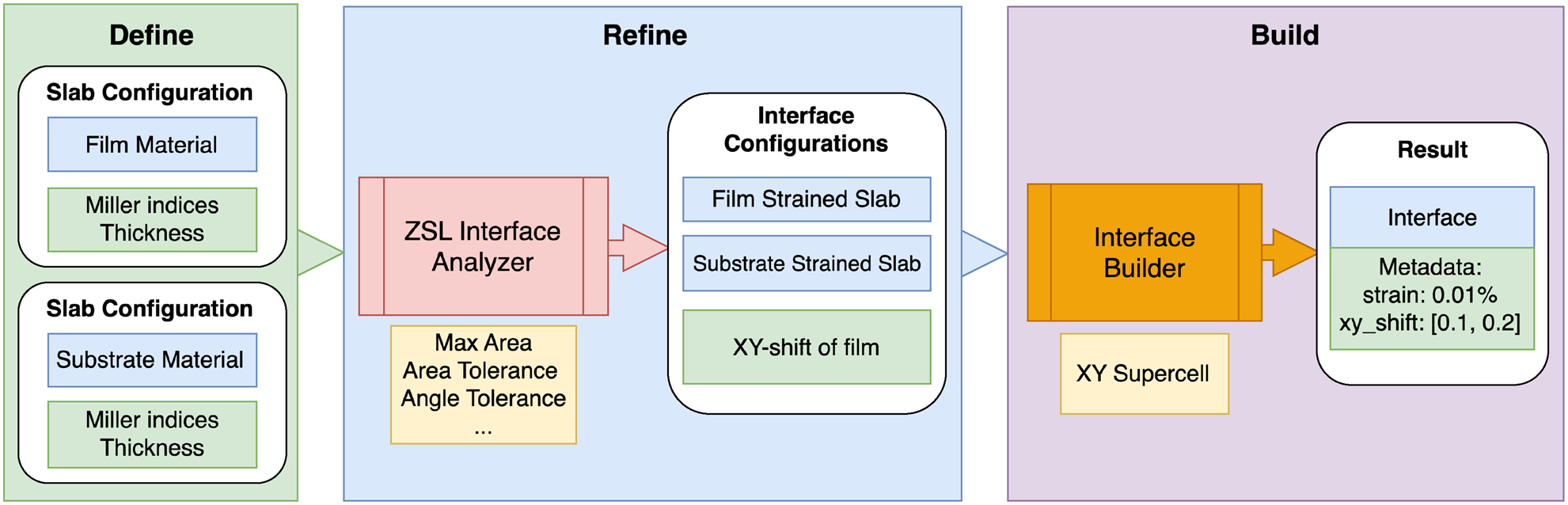
Mat3ra-2D is an open-source framework for the rapid design of realistic 2D materials and related structures: slabs, heterogeneous interfaces, defects and disorder. It rests on two pillars:
The software stack consists of five packages:
It is interoperable with pymatgen and ASE.
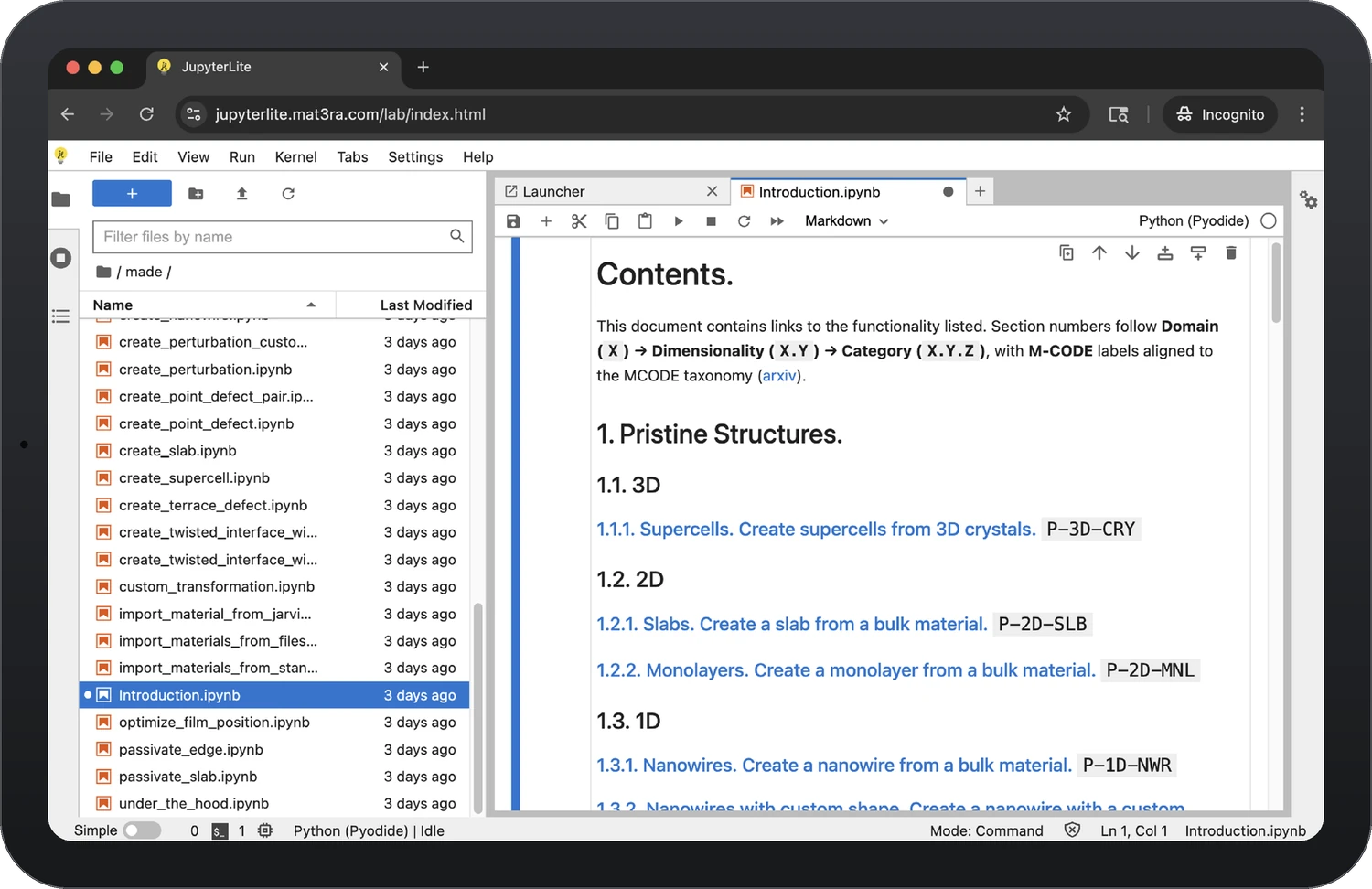
The paper comes with 23 reusable notebooks. They cover slabs, monolayers, nanowires, nanoribbons, clusters, heterostructures, interfaces, twisted interfaces, adatoms, islands, terraces, grain boundaries, point defects, passivation, perturbations and cutouts. They run in any web browser via JupyterLite and Pyodide, with no local installation: jupyterlite.mat3ra.com.
Representative structures are available in the public Materials Explorer on platform.mat3ra.com and are archived on Figshare with full provenance metadata: doi.org/10.6084/m9.figshare.32786562.
The paper covers the structure-generation layer that comes before property calculations and ML training. It does not replace validation against experiment. The next steps are validation, scalable dataset design, executable workflows, calculated properties, and dataset generation for downstream AI/ML.
Biryukov, V., Choudhary, K., Bazhirov, T. AI-ready design of realistic 2D materials and interfaces with Mat3ra-2D. Scientific Reports (Nature Portfolio), published online October 14, 2026. DOI: 10.1038/s41598-026-72825-z.
Read the paper: nature.com/articles/s41598-026-72825-z. This is the early “Article in Press” version; the final edited version will replace it under the same DOI. The work was supported in part by NIST 70NANB24H205.

Exabyte Inc.
1212 Broadway Plaza, Ste #2100 Walnut Creek, CA 94596
+1 (510) 473 7770
info@mat3ra.com
Mat3ra Japan K.K.
Otemachi Building 6F Inspired Lab,
1-6-1, Otemachi, Chiyoda-ku, Tokyo 100-0004 Japan


