
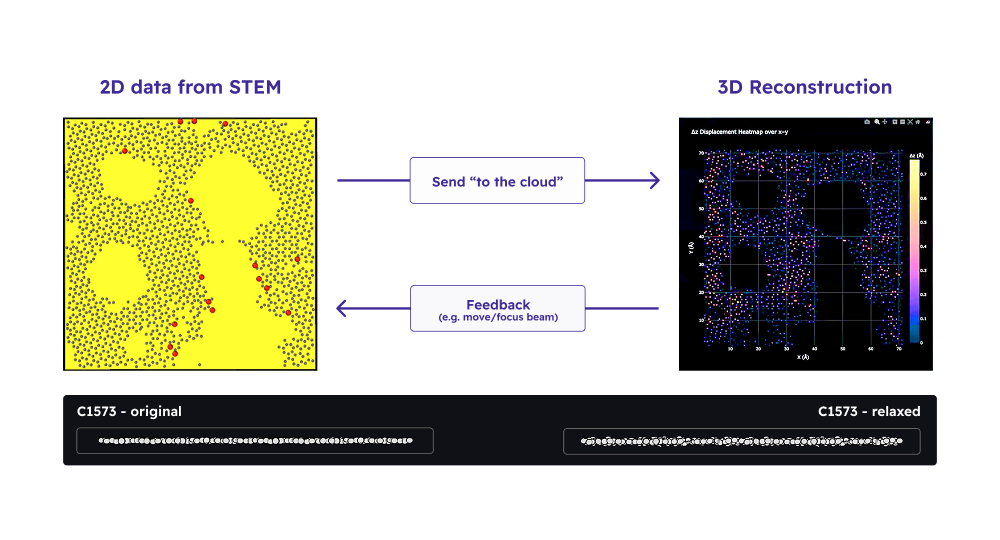
USE CASE 4 STEM — Experiment + Theory Loop illustrates the Connecting Experiment and Theory paradigm in materials research. Machine learning extracts atomic features from STEM imaging and integrates them into high-throughput simulations. Computational results feed back into experiments, enabling 3D reconstruction from 2D STEM data and improving beam positioning and experimental setup.
USE CASE 4 STEM — Experiment + Theory Loop illustrates the Connecting Experiment and Theory paradigm in materials research. This scientific workflow leverages machine learning to extract atomic features from Scanning Transmission Electron Microscopy (STEM) imaging, integrates ML outputs into high-throughput theoretical simulations, and closes the loop by using computational insights to refine experimental conditions and accelerate discovery. In particular, we demonstrate how a 3D reconstruction from a set of 2D STEM images is performed using physics-based models, with feedback to experimental beam positioning and setup.

Exabyte Inc.
1212 Broadway Plaza, Ste #2100 Walnut Creek, CA 94596
+1 (510) 473 7770
info@mat3ra.com
Mat3ra Japan K.K.
Otemachi Building 6F Inspired Lab,
1-6-1, Otemachi, Chiyoda-ku, Tokyo 100-0004 Japan


